 Just in —

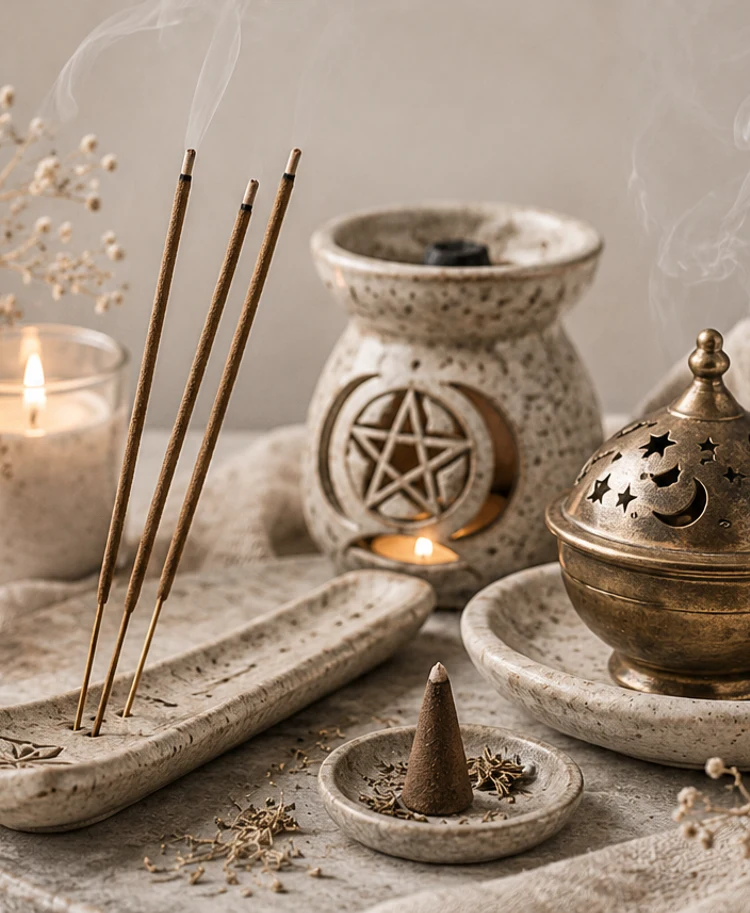
Incense comes in five common forms, and the mistake almost everyone makes at the start is buying one form and a burner meant for another. Sort that out first and the rest is straightforward.
The five forms
Sticks
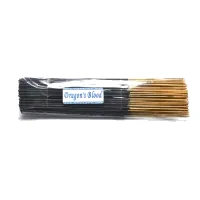
The most forgiving place to start. Two constructions: cored sticks are paste rolled onto a thin bamboo splint — the splint burns too, adding a faint woody note — and solid or extruded sticks are all incense. Either needs a holder that catches ash along the whole length, not just under the tip. Burn time runs roughly 20 to 60 minutes depending on thickness.
Cones
Short and concentrated: more smoke, over less time, from a smaller object. They need a flat heatproof surface — a dish, a tile, a cone burner with a recessed well. Backflow cones are a different item again, hollow-bottomed and made for a burner with a channel that carries the smoke downward; a backflow cone in an ordinary dish just smokes upward like any other.
Resin
Frankincense, myrrh, copal, dragon's blood and the rest are tree resins that do not burn on their own — they need a heat source underneath. Traditionally that is a self-igniting charcoal disc; see below. Resin gives the deepest, most enveloping smoke of any form, and it is the one that demands the most respect from you.
Powder and loose blends
Burned on charcoal like resin, or shaped into a trail on an ash bed. Blends let you mix your own; they also make far more smoke than a beginner expects, so start with a pinch.
Rope
Tibetan-style twisted cords, usually hung from a hook over a dish or draped across a burner so the ash falls clear. Long, slow and low-smoke compared to cones.
Before you light anything
Every form in this guide works by smouldering, which means all of it is hot enough to matter and none of it stops being hot when you stop looking at it. Resin on charcoal is the one that catches people out.
- A charcoal disc is not a candle. It reaches several hundred degrees and holds that heat long after it has stopped glowing and looks like cold grey ash. Handle it with tongs and never with fingers, and give it a bed of sand or ash at least a centimetre deep in a cast, brass or ceramic burner. The sand is insulation, not decoration: it is the only thing between that heat and whatever the burner is standing on.
- Everything that burns wants a heatproof dish under its whole length. Sticks drop ash the entire way down, not only at the tip; cones and self-igniting discs crackle and spit as they catch. A holder that supports the end alone is not enough.
- Nothing above it and nothing beside it. A shelf, a curtain, a trailing plant, a stack of paper. Rising smoke carries heat with it, and the bundle of spare sticks left next to a lit one is kindling.
- Put it out properly, then check it again. Quench a spent disc under the tap rather than trusting it to die on its own, because one left sitting in a burner can stay dangerous for an hour or more. Never leave anything burning when you leave the room.
- Ventilate, and think about who else is breathing it. Incense smoke is particulate. Crack a window, do not burn in a small closed room for hours, and be considerate of anyone in the house with asthma or a respiratory condition. Birds are markedly sensitive to airborne smoke and aerosols and should be out of the room altogether.
If the room is hazy, that is already more than you need. The smoke is a carrier, not the point.
Working with charcoal
With the burner filled and the tongs to hand, the sequence is:
- Fill a cast, brass or ceramic burner with a bed of sand or ash — at least a centimetre. The sand is insulation, not decoration, and it is what keeps the heat off the surface underneath.
- Hold the disc at its edge with tongs, never fingers. Light the edge and wait for the spark to travel across the face; self-igniting discs crackle and spit while this happens.
- Set it in the sand, dimple side up, and give it a few minutes to ash over evenly.
- Add resin a few grains at a time. Too much at once smothers the coal and produces a bitter, heavy smoke.
- When you are done, quench the disc under running water.
A mica plate or a thin metal screen set over the coal gives you gentler, sweeter smoke — the resin melts rather than combusts. It is slower and it does not smell burnt.
Choosing a scent
Rough families, if you have nothing to go on:
- Resinous — frankincense, myrrh, copal. Dry, warm, ecclesiastical.
- Woody — sandalwood, cedar, palo santo, agarwood. Soft and grounding.
- Herbal — sage, lavender, rosemary, sweetgrass. Green and sharp.
- Floral — rose, jasmine, ylang ylang. Sweet, and the easiest family to overdo.
- Spiced — cinnamon, clove, nag champa. Rich and heavy.
Scent is personal and memory-bound in a way no description survives. Buying a small sampler across two or three families tells you more than any amount of reading.
Shop the guide
What is covered above: